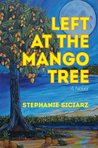
 Left at the Mango Tree by Stephanie Siciarz
Genre: Fiction > Literary
My rating: 5 of 5 stars
DESCRIPTION: Left at the Mango Tree is the story of Almondine Orlean. Almondine is white. Everyone else on the island of Oh is black. Things like that happen there. The moon plays tricks. The leaves sing. And one day the island itself summons home the grown-up Almondine to piece together her black-and-white past. She will reconstruct the efforts of her grandfather—a book-loving, magic-hating, Customs and Excise Officer named Raoul—to explain his new white grandbaby, a case of island magic if ever there was. As Raoul struggles to prove otherwise (for surely otherwise it has to be!), Oh’s pineapples begin to disappear. Acres without a trace, and Officer Raoul must find out how and why. With help and hindrance from his favorite novel and his three real-life chums, Raoul will risk his reputation, his sanity, and even his life, to solve not one island riddle but two—and to reveal, if he dare, the secrets hidden between the shady mango and the shiny moon.
REVIEW: Throughout my reading of this shining debut novel, I felt like I was dancing.
The dance, it turns out, is the Island of Oh.
Through Siciarz's superb writing Oh breathes. It lives at the macro scale, comprised of ocean waters and currents, sandy shores, inland streams, undulating landscapes, whispering leaves on swaying trees—and people. All respond to the seemingly fickle, sometimes cantankerous, other times playful movements of sun, moon, rain and wind.
No surprise that the Islanders' lives mirror Oh's rhythms, merging and serving counterpoint within the dance.
Stunning, however, is the gorgeous writing that makes the dance of Oh so evident. While absorbing Siciarz's lyrical language, I felt responses deep in my gut, Oh's rhythms twitching my muscles and bobbing my head. More than once I resisted overt movements, lest other people spy me leaning fore or aft, port or starboard.
From the first page, Oh captures the disembarking passenger:
When you arrive at Oh, they don’t stamp your passport. You make your way bovinely through zigs and zags of blue plastic rope that navigate the gritty concrete of the airport floor, a sandpaper sea emptying into the river of Raoul. Behind the Formica counter from which he draws his authority, Raoul is an impressive sight. Flanked and backed by wooden cratefuls of pineapple, his black skin shines with subtle sweat against the pallor of the plywood slats, while the dull metal of his rounded specs vaguely obtrudes, like an artist’s signature on still life. His close-cropped hair and pronounced but gentle features foreshadow his demeanor, pointedly official, but given to flights of unofficial tolerance.From collecting one's baggage and exiting the airport—where one meets Bang, a Pineapple-cutter extraordinaire—, to riding stickily (the pineapple) from airport to town in a taxicab driven by Nat, another featured character, Oh has the reader in its thrall.
You reach his post, dulled by the sight, the scent, the oddity of the scene, and extend your passport with the trepidation of one who desires what another has the power to refuse. Raoul takes the document and thumbs the pages. He glances at you, at your picture, and back at you again. This he does less to verify your identity than to ponder how it is you came to be from where you’re from. Were it only as simple as a passport!
When he’s satisfied, he types your name on a carbon-paper form in his typewriter that records your arrival, date of birth, and eye color in triplicate, which he prises from the roller’s grip with an impatient “aaah.” He removes the dry end of an ink stamp from between his teeth and expels a “huh, huh” as he pounds it first onto his inkpad and then onto your triplicate form one time. Then in a single, masterful sleight of hand, Raoul completes the transaction, and you find yourself, passport and creased copy three in your left palm, a pineapple in your right. And so to the rhythmic aaah-huh-huhs of Raoul the line slowly scrapes forward, his airy triads punctuated with a My word! or a What’s this? or a hesitant Thank you very much....
The mystery that weaves throughout the novel cleaves no less to the rhythms and fickleness of Oh's moods than do its individual characters. And its ultimate resolution, while too coincidental to be believed had the mystery occurred in a city setting, makes perfect sense on the island of Oh, whose internally consistent rhythms must be honoured.
Siciarz has written a second novel, Away with the Fishes, which also takes place on Oh and involves another mystery.
I shall be making the return trip. The author's superb writing, wondrous language, enchanting storytelling and fully-imagined world are too much for this reader to resist.
View all my reviews