Thursday, May 15, 2014

The Atlantis Gene by A. G. Riddle (Origins Mystery, #01)

The Atlantis Gene (Origins Mystery #01)The Atlantis Gene by A.G. Riddle
Genre: Science Fiction, Speculative Fiction
My rating: 2 of 5 stars

DESCRIPTION: 70,000 years ago, the human race almost went extinct. It survived, but no one knows how.... Until now. The countdown to the next stage of human evolution is about to begin, and humanity may not survive this time....

The Immari are good at keeping secrets. For 2,000 years, hid the truth about human evolution while they searched for an ancient enemy; a threat that could wipe out the human race. Now the search is over.

Off the coast of Antarctica, a research vessel discovers a structure buried deep in an iceberg. It's been there for thousands of years, and it isn’t man made. This discovery prompts the Immari to execute their master plan, because humanity must evolve or perish. Key to that plan is autism research being done by a brilliant geneticist in a lab in Indonesia.

Dr. Kate Warner's discovery could rewrite human history and unleash the next stage of human evolution. But in the hands of the Immari, it would mean the end of humanity as we know it.

One man has seen pieces of the Immari conspiracy: Agent David Vale. But he’s out of time to stop it. His informant is dead. His organization has been infiltrated. His enemy is hunting him. But when he receives a cryptic code from an anonymous source, he risks everything to save the only person that can solve it: Dr. Warner.

Together, Kate and David race across the globe, and into the secrets of their own pasts, to unravel a global conspiracy and learn the truth about the Atlantis Gene and human origins. Meanwhile, the Immari close in and will stop at nothing to find the Atlantis Gene and force the next stage of human evolution — even if it means killing the majority of the world’s human population.

REVIEW: The good: The novel's focal theme - the next evolutionary event for humankind - lends an author plenty of possible, plausible, hard science fiction storylines with which to work. That the topic has long been a fascination of mine, be it woven into speculations about the coming singularity or not, had me anticipating an absorbing read….

Alas, it didn't work out that way.

The bad: The author attempts to build his story by layering one theory on top of another and then another. Which is fine, except some of the theories have real-world scientific consensus while others remain unsubstantiated or have been relegated to the dust heap of pseudo science quackery. Readers are expected to withhold judgment each time another of the latter sort is resurrected, while being provided no reasonable justification for doing so - such as new (scientifically plausible, albeit fictional) evidence in support of it. The story then continues upon that shaky foundation until we happen upon another unsubstantiated theory, which is added atop the others.

By the time I got to Chapter 117 and the "Spear of Destiny," (some myth surrounding the Christian Jesus) I was desperate to get the book over with.

Having reached that chapter number, I might normally have supposed I was indeed near the end. But not here. The book has 153 chapters, plus an Epilogue. I'd still quite a way to go. The sheer number of chapters made the book read more like a series of short scenes - in an unedited screenplay.

Added to these problems is the implausible action. The two main protagonists are David Vale, an elite security professional, a man near the top in his security organization; and Dr. Kate Warner, a medical researcher without a security background or, seemingly, athletic abilities or training. Yet they manage to extricate themselves time after time from seeming certain death … against large teams of highly trained security professionals … while Vale is occasionally in the early stages of recovering from near-fatal and incapacitating injuries … and Warner is doing the rescuing.

My overall advice to the author: If there is to be a revised edition of the book, flesh out Kate Warner's background with some security, military, athletic or other intensive physical training. And dial back the imminent-death action vs. characters who are ill-equipped to defend themselves. Have one or the other, but not both.

The other problems lie chiefly in the lack of evidence provided in support of each new, theoretical plot point. The story leans heavily on these theories. So…, flesh them out! If a hypothesis lacks current, real-world, scientific consensus, defend your adoption of it. This is fiction. An author has licence to imagine or concoct, as needed, new (scientifically viable) evidence that would make an implausible view seem plausible. Scant descriptions are not enough, certainly not for a novel that be aiming for the 'hard science fiction' seal of approval.

Those points aside, The Atlantis Gene was A.G. Riddle's debut novel. For that reason and because the focal theme remains one that interests me, I plan to read the next book in the trilogy, The Atlantis Plague. That I'd already bought the second book provides the key additional incentive.

Am hoping, and expecting the second novel to be an improvement over the author's first effort… And having just written that sentence, I notice that the final book in the trilogy has just come out, The Atlantis World.

View all my reviews

Wednesday, May 14, 2014

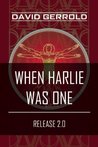
When HARLIE was One: Release 2.0 by David Gerrold

When HARLIE Was One: Release 2.0When HARLIE Was One: Release 2.0 by David Gerrold
Genre: Science Fiction > Hard Sci-Fi, Soft Sci-Fi, AI | Philosophy
My rating: 5 of 5 stars

DESCRIPTION: Originally published in 1972, When HARLIE was One was nominated that same year for the Nebula Award for Best Novel and for the Hugo Award for Best Novel in 1973. A revised version, subtitled "Release 2.0", was published in 1988.

Central to the story is an Artificial Intelligence named HARLIE - an acronym for Human Analog Replication, Lethetic Intelligence Engine. The story revolves around HARLIE's relationship with David Auberson, the psychologist responsible for guiding the AI from childhood into adulthood. It's also the story of HARLIE's fight against being turned off and the philosophical question whether or not HARLIE is human; for that matter, what it means to be human.

The HARLIE intelligence engine appears in a number of Gerrold's other works, including the Star Wolf series, where it is routinely installed as the administrating AI of Terran warships.

REVIEW: Was up until the wee hours of the morning re-reading this novel, unable to put it down. Had never owned a copy before, my first read of it having been a library lend, of the dead tree version and oh-so-many decades ago.

Am going to want to read this novel again, at least a third time. Plus any other stories by David Gerrold, especially any in which HARLIE reappears.

If you like your science fiction full of blood, guts and gore; or replete with military action and the latest materiel; or starred with cyborgs bent on overtaking Earth and destroying humankind; or to be yet one more in a seemingly endless inundation of dystopian novels, then you will hate this book.

If you like your science fiction to make you think, to force those little grey cells to fire excitedly..., if you want your science fiction to challenge your preconceptions..., or even to read like some of the best Socratic dialogues, then you will love it. As I did.

This is the kind of science fiction I like best. More, please!

View all my reviews

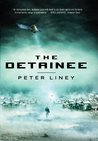
The Detainee by Peter Liney (Detainee #01)

The Detainee (The Detainee #1)The Detainee by Peter Liney
Genre: Science Fiction > Dystopia
My rating: 3 of 5 stars

DESCRIPTION: Peter Liney honed his strong narrative skills and attention to detail during his long career as a writer of German, Australian, British, and South African television and radio programs. In his debut novel, The Detainee, Liney has crated a dystopian world in which the state has gone bust and can no longer support its weakest members.

The Island is a place of hopelessness. The Island is death. And it is to this place that all the elderly and infirm are shipped, the scapegoats for the collapse of society. There’s no escape, not from the punishment satellites that deliver instant judgment for any crime—including escape attempts—and not from the demons that come on foggy nights, when the satellites are all but blind. But when one of the Island’s inhabitants, the aging "Big Guy" Clancy, finds a network of tunnels beneath the waste, there is suddenly hope—for love, for escape, and for the chance to fight back.

REVIEW: Much of this novel I enjoyed. The main storyline intrigued me, despite my usual antipathy toward dystopian themes. It had me hooked and reading well past bedtime straight through to the end.

The trouble was the ending, which came far too suddenly. Until then, I thought I had been reading an intelligent, internally-consistent novel.

The careful pacing of the first two-thirds of the book set up the expectation of a different outcome, one that would not see the protagonists having advanced as far as they did.

It felt to me like another novel could have been written between the conclusion of the pivotal conflict described in Chapter 19 and the conclusion of the book in Chapter 20. Events suddenly seemed hurried and were inconsistent with the earlier pacing and the status quo on and off the island that had been described throughout the book previously.

Rather than an excellent novel, it began to feel like the poorly-scripted, rushed ending of a made-for-TV rendition of such a novel. One of the major sticking points, for example, was the unrealistic, sudden turnabout of children who had been traumatized, brutalized and manipulated over much, and for some of them, all of their lives. Until that point, the novel had been internally consistent and psychologically spot-on.

I understand there will be two more books within the same theme, to form a trilogy... and I hope to read the second book and perhaps the third one. However, given an entire period of events is missing for me, which feels like a betrayal of the characters, my enjoyment of it may be negatively affected.

View all my reviews

Monday, May 12, 2014

Space Slugs by Frances Pauli (Space Slugs #01)

Space SlugsSpace Slugs by Frances Pauli
Genre: Space Opera, Fantasy
My rating: 2 of 5 stars

DESCRIPTION: When Murray receives another phony wedding invitation from her galaxy hopping sister, Zora, she hops the first flight to an obscure planet at the edge of the civilized universe. But instead of a wedding, Murray finds her sister imprisoned by an alien overlord. With the assistance of a mysterious android and the universe's last living space slug, the women end up the run in a stolen space ship with half the galaxy in hot pursuit. Thanks to Zora, it's the least desirable half. Maybe Murray will get lucky, and the crash landing will kill her.

REVIEW: I obtained this book free. Unfortunately, I don't recall if it was from the author's own website or from Smashwords. At any rate, because I obtained it free and because Frances Pauli is an independent author, I vowed to write a review after reading it.*

Then surprised myself finding that I quite liked it! Space Slugs is fun, light-hearted, and original.

When I began, I was not expecting much, that impression initially formed on the basis of this ebook's poor formatting. Style and presentation are important to me, and I suggest the book be put through a decent editor to check for errors and for general clean-up operations. (The editor that comes with Calibre would serve.)

I also suggest an editor of the old-fashioned kind (i.e., a human) go over the dialogue structure. Too many times it was unclear to me who was doing the talking. Such confusion for readers interrupts a story's pacing. Merely correcting the paragraph breaks, punctuation, and he-saids/she-saids would address that problem.

Apparently, there is a sequel to this book, titled Slug Opera. While I'm disinclined to buy that book, I am curious to know if its dialogue structure shows improvement and how the story ends.

If you're someone who wants science, hard or soft, in their science fiction, then this book is not for you. There's virtually none of it here. If you're looking for a light-hearted, somewhat idiotic space-opera romp in a sort of Jetsons future, you might give this one a try.

*I do not review every book I read. I'd guess the ratio of reviews written, as of the date I began writing reviews, to books read would be roughly 75 percent. Books that get a 'meh' reaction from me tend not to be motivating enough to put virtual pen to virtual paper.

View all my reviews

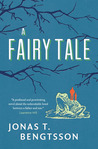
A Fairy Tale by Jonas Bengtsson

A Fairy TaleA Fairy Tale by Jonas Bengtsson
Genre: Literature and Fiction, Literary
My rating: 4.5 stars

DESCRIPTION: From one of Denmark’s rising stars, a powerful and profound novel about a young boy and his father who live at the margins of society, until one day their adventure takes an unpredictable turn.

It is 1986. Swedish Prime Minister Olof Palme has been assassinated, and a young boy and his father are on the move again. Travelling from Sweden to the outskirts of Denmark and into the heart of Copenhagen, the two live an unconventional life, constantly on the move and living on the margins of society. The father, an eccentric, restless man, takes a series of odd jobs, from making antique furniture, to landscaping, to working as a bouncer at a strip club. By day he home-schools his young son. At night he weaves a fairy tale about a prince and a king who are on a mission to kill the wicked White Queen, while running from the White Men who hide in plain sight.

One day, their adventure takes a dark, unpredictable turn. Ten years later, when the boy is just entering adulthood, questions about his father’s murky past can no longer remain unanswered. An unforgettable novel about the profound love between a father and son.

REVIEW: On May 2/14, I wrote, "Just finished A Fairy Tale by Jonas Bengtsson. Profoundly moving. Had to remind myself to breathe after turning the last page."

May 4/14: The story was too fresh for me two days ago, the feelings too raw, to write more then...

The events that unfold in the story are told from the son's point of view, from the time he is six through (I am guessing) 19 or 20. Later parts in the novel gave me the sense of the story going nowhere, and I think that was the point; to portray a life only borne and as if in a thick envelope of fog. Not a life lived. Other parts of the story, from earlier in the boy's life, are joyful, playful, adventurous for both father and son.

The bond between the two seems unbreakable, no matter what may come or what may try to wrench them apart.

No book before this has helped me understand how powerful and crucial can be the connection between a father and his son. The love and protection this father feels for his little boy moved me the most. But the son's love for and tremendous pride in his father, while less fierce in intensity, is no less evident, nor any less steadfast and pure.

Did later events, and the life the two led once seen from a now adult perspective, tarnish the son's affection and pride for his father? In my view, no, and nothing that happened subsequent to those intense, early, crucial, formative years of their relationship could have done so.

Due to that early, loving bond, as the father protected his son, so would the son protect his father. An absolutely beautiful tale, one I highly recommend.

View all my reviews

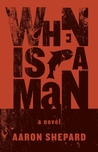
When is a Man by Aaron Shepard

When is a ManWhen is a Man by Aaron Shepard
My rating: 3 of 5 stars

DESCRIPTION: Impotent and defeated, Paul Rasmussen — a young ethnographer and academic recovering from prostate cancer — retreats to the remote Immitoin Valley. As an outsider, he discovers how difficult it is to know a place, let alone become a part of it. Then, a drowned man and a series of encounters force him to confront the valley’s troubled past and his own uncertain future. As Paul undertakes a study of the families displaced 40 years earlier by the flooding of the valley to create the hydroelectric dam, his desire to reinvent himself runs up against the bitter emotions and mysterious connections that linger in the aftermath of the flood. Meditative and erotic, raw and exuberant in tone, When Is a Man goes beyond the familiar narratives of memory and loss to offer a fresh perspective on themes of body and landscape, impotence and masculinity.

REVIEW: No question that the writing is good, which is a prerequisite for me. And I found it easy to feel compassion for, and to like the main character, Paul Rasmussen, a 33-year-old male whose cancerous prostate gland had recently been removed.

But not until well past the halfway mark does the reader get a hint there may also be a mystery to solve. This, despite a dead body having been mentioned in the first few pages.

I found that off-putting, having been led to suppose by the book's lazy, meandering - but no less interesting - first half, that its primary theme was of a young man struggling to cope with a health issue that had him questioning his masculinity. The fact of a dead body was treated with the barest mention.

To be more than halfway through a book before a hint of real mystery insinuates itself and whatever action related to uncovering its answer begins to start is not a good thing.

The odd structure of the novel suggests to me that perhaps When is a Man ended up fusing what should have been two novels. It was either trying to say too much and in too much of a hurry - there was a heck of a lot to track in the latter third of the book - or, having begun so well in setting a theme of anxiety and identity loss against a gorgeous backdrop of lake, stream and forest, it has forgotten its main thread.

In other words, I felt I was reading a work of general fiction through much of the first half of the book, only to learn as I approached the last third that I was now reading a mystery novel.

Near the end, I began skipping pages - too many esoteric details thrown at me at once.

View all my reviews

The Riverman by Aaron Starmer

The Riverman (The Riverman Trilogy)The Riverman by Aaron Starmer
My rating: 5 of 5 stars

DESCRIPTION: "To sell a book, you need a description on the back. So here's mine: My name is Fiona Loomis. I was born on August 11, 1977. I am recording this message on the morning of October 13, 1989. Today I am thirteen years old. Not a day older. Not a day younger."

Fiona Loomis is Alice, back from Wonderland. She is Lucy, returned from Narnia. She is Coraline, home from the Other World. She is the girl we read about in storybooks, but here's the difference: She is real.

Twelve-year-old Alistair Cleary is her neighbor in a town where everyone knows each other. One afternoon, Fiona shows up at Alistair's doorstep with a strange proposition. She wants him to write her biography. What begins as an odd vanity project gradually turns into a frightening glimpse into a clearly troubled mind. For Fiona tells Alistair a secret. In her basement there's a gateway and it leads to the magical world of Aquavania, the place where stories are born. In Aquavania, there's a creature called the Riverman and he's stealing the souls of children. Fiona's soul could be next.

Alistair has a choice. He can believe her, or he can believe something else... something even more terrifying.

REVIEW: Aaron Starmer's The Riverman grabs the reader by the throat from the first sentence and doesn't let go until well after the last page is turned.

A dark, haunting sense of loss and foreboding, overlaying a persistent mystery, permeates this multi-layered, sophisticated story, which merges fantasy and reality. By the end of the novel, the reader wonders which is which, the fantasy or the reality, and where the truth - if it exists - lies.

The novel tells of a six week period during the life of a 12-year-old boy, Alistair, at a time during which he renews his old friendship with Fiona Loomis, questions other friendships, and wonders about the people he thought he knew.

Fiona says she chose to tell him her autobiography because "he is a boy who keeps secrets." Which begs the question: what other secrets lie beneath the surface of this seemingly tranquil community?

Told in the first person by Alistair, by the end of the story the reader is left to wonder if that, too, is not also a mystery… Perhaps Alistair is no longer 12… Perhaps he is now an older adolescent. Perhaps he is even a man.

Strong in establishing a pervasive uncertainty, Starmer never tries to trick the reader. Instead, he allows the story to unfold itself, as if it follows its own natural, developmental path. You never feel like you've been manipulated and there is not a single jarring moment.

Every sentence, every paragraph, and every page flows seamlessly from one to the next. By means of Starmer's superb writing, one gets the sense of his immense respect for the story's own integrity and life, for the persistence of its characters - who insist on being who they are and not what the author or anyone else, might want them to be; and respect for the reader, who is drawn into the story and feels almost to be part of it.

I finished the book about 24 hours before writing this review and read it over three days. (I typically have four books on the go at a time.) Throughout those three days and the next, The Riverman dwelt in the back of my mind.

I can only hope that Book 2 will become available soon. And then Book 3, to complete the trilogy.

"As far as I'm concerned, this is one of the best of 2014…," wrote Betsy Bird, writing in the Fuse #8 blog of the School Library Journal.

I couldn't agree more. If The Riverman doesn't win multiple awards, I will question the book awards business.

Meanwhile, I highly recommend The Riverman for anyone over the age of 12, including adults.

View all my reviews

My Promised Land: The Triumph and Tragedy of Israel by Ari Shavit

My Promised Land: The Triumph and Tragedy of IsraelMy Promised Land: The Triumph and Tragedy of Israel by Ari Shavit
My rating: 5 of 5 stars

DESCRIPTION: A groundbreaking, ambitious, and authoritative examination of Israel by one of the most influential columnists writing about the Middle East today.

My Promised Land tells the story of Israel as it has never been told before. Facing unprecedented internal and external pressures, Israel today is at a moment of existential crisis. Through revealing stories of significant events and of ordinary individuals—pioneers, immigrants, entrepreneurs, scientists, army generals, peaceniks, settlers, and Palestinians—Israeli journalist Ari Shavit illuminates many of the pivotal moments of the Zionist century that led Israel to where it is today. We meet the youth group leader who recognized the potential of Masada as a powerful symbol for Zionism; the young farmer who bought an orange grove from his Arab neighbor in the 1920s, and with the Jaffa orange helped to create a booming economy in Palestine; the engineer who was instrumental in developing Israel’s nuclear program; the religious Zionists who started the settler movement. Over an illustrious career that has spanned almost thirty years, Shavit has had rare access to people from across the Israeli political, economic, and social spectrum, and in this ambitious work he tells a riveting story that is both deeply human and of profound historical dimension.

As it examines the complexities and contradictions of the Israeli condition, My Promised Land asks difficult but important questions: Why did Israel come to be? How did it come to be? And can Israel survive? Culminating with an analysis of the issues and threats that Israel is currently facing, both internal and external, My Promised Land uses the defining events of the past to shed new light on the present. The result is a landmark portrait of a small, vibrant country living on the edge, whose identity and presence play a crucial role in today’s global political landscape.

REVIEW: I came upon this book having read nothing in-depth previously about Israel or the history of the Jewish people. My educational exposure had been limited to my half-hearted, soon-to-be abandoned effort in early childhood to read the Old Testament and Christian Bible; the subjects' cursory treatment in school; and later, reports and commentary in news media. While media reports and commentary helped to inform, they could not patch the gaps in my knowledge.

My Promised Land transformed this reader from a person who was largely oblivious of the issues, and therefore disinterested, to someone fueled by a keen desire to learn more about the Jewish people, and their ancient history and earliest origins.

How could a book of non-fiction inspire in that way?

Ari Shavit wrote a love letter to and on behalf of Israel. It's a love letter filled with aching pride, affection - and equal shame. It soars with hope - then plummets to the depths of despair. Its words sparkle with brilliant clarity, amidst arrant confusion. Shavit wrote his book of non-fiction like a novel of the best contemporary literature.

My Promised Land is a journey of self-discovery for both the man and his people. It's at once a deeply personal history and the history of a young nation. The author tells the tale of his ancestors and those of others, the details of their lives uncovered from long-buried or previously unknown photographs and records. Then he describes events and locations of almost two centuries ago as if he were there, as though he had jumped into a time machine and transported himself to those places. Through artful language, he then describes what he sees, hears, smells and feels so that, in turn, the reader is also transported.

I was taken particularly by Shavit's story of a 1930s orange grove, one which had been located in the Jewish colony of Rehovot in Palestine, in a period not long before all hell broke loose. An entire chapter is devoted to the birth and growth of Israel's orange industry.

Prior to the passage I quote below, Shavit has described in exquisite detail how the owner and his orange grove came to be, at this time and in this place. How the land would have been ploughed, the water canals dug, and the hoped-for orange trees seeded. How and when the first shoots of the young trees would have appeared. And how the relations among neighbours, Arab and Jew, grew from curiosity to conviviality, to their visiting each others' homes, sharing meals and enjoying festivities together.
The first season of the young orange grove is critical. The orange grower has to start up the formidable pump that draws water from the deep well. He has to clear out the irrigation canals into which unripe fruit has fallen in winter. He has to redig the furrows and bowls, and weed, clean, and dispose of dry thorny branches. He has to make sure that all is set for the first rains of summer.

At the end of April 1935, disaster strikes in the form of a heat wave…. If action is not taken immediately, half of the orange crop will be lost and the citrus season of 1935–36 will be a bust. The first watering of the young Rehovot grove is therefore an act of emergency. The pump pulls the clear water to the pool, and from there the water travels down the open, cemented canals until it emerges from the circular openings of the clay grate into the sandy furrows. The Arab guardian, his pants hiked up to his knees, his bare feet covered in mud, guides the water with a hoe from tree to tree. He quickly traps the water by each tree with a tall mound of soil so that the trees would be able to withstand the deadly dry desert winds.

The heat wave brings with it a sense of panic. More water is needed quickly. They must save what can be saved. The orange grower and the Arab guardian are joined by their families, who work beside them in the stifling heat. Still, in the midst of the panic they can hear the sounds of children’s gaiety, shouting in Hebrew and in Arabic, as they run to watch the gushing water. After the children lend their small hands to the great common effort, they steal away to the square pool and jump gleefully into its cool waters. While the adults are still struggling with the heat and with the sense of approaching calamity, the youngsters discover all that is forbidden, wondrous, and fun in this man-made Garden of Eden.

It is not all so tranquil and not long thereafter conflict erupts.

A Jew born in Israel, Shavit knows that only facing the truth of Israel's creation and the circumstances of its present, in all its history's bald, brutal detail will save the young nation's future. An example is the author's blunt description of the 1948 Lydda slaughter which began Israel's ousting of Palestinians from their homes. Those who had been brutally dispossessed in turn dispossessed Palestinians, uprooting them from homes in which the Palestinians' own ancestors had been born centuries past. Shavit devotes an entire chapter to Lydda alone.

It's clear that Shavit's heart breaks at the atrocities and injustices done by the Zionists. It is clear also that, while he abhors the means, he recognizes the necessity of the outcome, for otherwise there would have been no Israel and no Israelis, such as one named Ari Shavit.

I've only one criticism about the book. It began to drag near the end and could have been about 50 pages shorter. Shavit excels at painting in words the reality suggested by old records and photos. However, when he waxes philosophical, he frequently repeats the same idea over several sentences; and he waxed most philosophical near the end of the book. That is a minor criticism, however, one merely worth the docking of half a star. Since a half-star isn't an option, I rate this book five stars.

Thanks to My Promised Land, I shan't soon forget the names of persons and places I'd not heard of previously. I'll not forget Lydda; and I want to go back and read that chapter again - and likely, again. Nor will I forget that orange grove owner or his Arab guardian, both of whom worked side-by-side to save the young orange trees. And I am determined now to learn more about Israel and her people.

View all my reviews

The Longer I'm Prime Minister by Paul Wells

The Longer I'm Prime Minister: Stephen Harper and Canada, 2006-The Longer I'm Prime Minister: Stephen Harper and Canada, 2006- by Paul Wells
My rating: 5 of 5 stars

DESCRIPTION: The definitive portrait of Stephen Harper in power - and of the impact his government is having on Canada - by this country's most trenchant, influential and surprising political commentator.

Stephen Harper is on his way to becoming one of Canada's most significant prime ministers. He has already been in power longer than Pearson and Diefenbaker. By the end of this majority term, he'll have caught up to Brian Mulroney. And with that majority in hand, he's been moving more boldly to build the Canada he wants and to entrench the Conservatives as the twenty-first century's "natural governing party."

In The Longer I'm Prime Minister, Paul Wells explains Harper not only to Harper supporters but also to readers who can't believe he is Canada's prime minister. Harper has been elected three times and Conservative Party support grew in every election. As Wells writes, "He could not win without widespread support in the land … which suggests that Harper has what every successful federal leader has needed to survive over a long stretch of time: a superior understanding of Canada." Too many people who oppose Harper try to ignore him or dismiss him or discount what he clearly knows about the Canadian electorate. But as Wells writes in this authoritative, engaging and sometimes deeply critical account of the man and Canada, " Harper endures. I figure it is not too soon to try to understand him."

REVIEW: I have read journalist Paul Wells' political writings posted online and those written for Maclean's Magazine with fair regularity. Therefore, I had become accustomed to expecting prose that made dry, political topics easier (juicier?) to swallow. Even so, I had not expected a 448-page book on Canada's difficult-to-know, insistently-beige 22nd Prime Minister to be such a romp to read.

And it's not just a romp…. it's insightful. Wells explains actions by Stephen Harper, Prime Minister, which have baffled even the experts, let alone the rest of Canadians. For example:
Economists had mocked the GST reduction [from seven to five percent] as the worst possible tax cut because it did less than income-tax cuts to stimulate productivity. But that was not the point. The point was to get money out of Ottawa, to reduce surpluses and restrict the ability of the government - any government - to introduce elaborate new social programs. And it had to be hard to reverse without substantial political cost. Same for the $100 cheque per month per child under six. A government handing out those cheques couldn't run daycares too, and a government that cancelled those cheques would have hell on its hands.

In reading that, I had just learned something, and my persistent befuddlement regarding certain of Harpers' actions had lifted. From the outset, Harper has been determined to remake Canada into a conservative nation, to prevent Canadians from viewing the Liberal Party of Canada as the nation's 'natural governing party'. To, in fact, have us replace the Liberals with Conservatives as our default electoral option.

If you starve the beast - in this case the federal government - then ANY government led by ANY party, will have its hands tied in terms of what it can do. THAT is the point to so many of Harper's actions, as Wells had just made clear for me.

But let's get to the romp, to the funny side of politics, which Wells helpfully - and with seeming glee - brings to light. Consider, for example, how he reviews an exchange in December 2008, between Liberal Opposition Leader Stéphane Dion and Prime Minister Stephen Harper, during the daily farce we Canadians affectionately - or more, hopefully - refer to as Question Period.

Dion, together with NDP Leader Jack Layton and Bloc Quebecois Leader Gilles Duceppe had just announced the day previously that they had entered into an agreement 1) to vote non-confidence in the Harper government and 2) to present to the Governor-General the constitutionally-viable option of the Liberals and NDP, together with support from the Bloc, forming a coalition government. The two sides, in other words, had FINALLY, after far too many false starts, met at the OK Corral. And the Dion-led Liberals had drawn the first gun. (About damn time, weary Canadians thought.)

This is the following day....

Scene: House of Commons. Question Period. Televised. All eyes on Dion. All eyes next on the Prime Minister.

Here's Wells:
So they all filed into the Commons and waited their turn, and Stéphane Dion stood up and put on his tiny perfect Stéphane Dion scowl, and asked his defiant Stéphane Dion question. He read from an old quote about how "the whole principle of our democracy is the government is supposed to be able to face the House of Commons any day on a vote." Failing to face a confidence test, he said, still reading the old blind quote, was "a violation of the fundamental constitutional principles of our democracy." And here came his question:

"Can the prime minister inform the House who said these words?"

Oooh, let me guess. It was Stephen Harper, right? Here was a favourite Dion tactic. Put your opponent's words to him. Make him face his contradictions. It was neat and clever and about five times too subtle for the moment at hand, because what Harper did was pull himself up to his full height, button his suit jacket, lean forward across the aisle of the Commons, and bite Dion's head clean off.

"Mr. Speaker, the highest principle of Canadian democracy is that if you want to be prime minister, you get your mandate from the Canadian people, not from Quebec separatists." This time [attractive, female Conservative MPs strategically placed within camera shot on benches behind the PM] Ablonczy and Guergis and Raitt behind him knew what to do [as they hadn't, notably, in an exchange days before], as did the rest of the Conservative caucus. They leapt to their feet as if prompted by cattle prods. A guttural roar went up from the applauding Conservatives. Lawrence Cannon, standing next to Harper, shouted a word that was probably supposed to be "Oui" but came out as if he'd suffered a back-alley appendectomy. "WAAAAAAAAEERRGH!"

Just about every paragraph of Wells' book reads like that. And because it does, because his humour and wit brings seemingly staid, static, boooorrring Canadian politics alive, Stephen Harper the man is made more knowable; and the actions of Stephen Harper, Prime Minister, are made more understandable. Not necessarily acceptable, but understandable.

Love Stephen Harper or hate him, cast him as milquetoast or charlatan, no Canadian - including those soon-to-be-electors in high school - should go without reading Paul Wells' The Longer I'm Prime Minister.

View all my reviews

The Age of Atheists by Peter Watson

The Age of Atheists: How We Have Sought to Live Since the Death of GodThe Age of Atheists: How We Have Sought to Live Since the Death of God by Peter Watson
My rating: 2 of 5 stars

DESCRIPTION: From one of Britain's most distinguished historians comes the stirring story of one of the modern world's most important yet controversial intellectual achievements: atheism.

Since Friedrich Nietzsche roundly declared that "God is dead" in 1882, a raft of reflective and courageous individuals have devoted their creative energies to devising ways to live without Him, turning instead to invention, enthusiasm, hope, wit and, above all, various forms of self-reliance. Their brave, imaginative story has gone untold - now. In The Age of Atheists, acclaimed historian Peter Watson offers a sweeping narrative of the secular philosophers and poets, psychologists and scientists, painters and playwrights, novelists and even choreographers who have forged a thrilling, bold path in the absence of religious belief.

Synthesizing nearly a century and a half of recent history, The Age of Atheists is a stunning, magisterial celebration of life without recourse to the supernatural.

REVIEW: Gave up on this book, something I'm always loathe to do.

As an atheist I'd had high hopes for it. And the promises in the Introduction suggested it might deliver too. Peter Watson's thesis had peaked my interest.

Then I began reading the first chapter ... and asking the question, 'Yes, and what's your point?' The author failed to relate the subject of that chapter, Nietszche, back to his thesis. Moreover, there were far too many quotes and not enough of Watson's own writing.

Chapters two and three were improvements. They told of the introduction and importance of the emergence of two philosophical schools of thought - pragmatism in North America and phenomenology in Europe. But once again, the reader isn't told how this discussion supports the author's thesis.

The following chapters of Part One (there are three parts) went downhill from there; choppy writing and the threads of whatever argument Watson might be making not woven together.

It shouldn't be the task of readers to make sense of nonsensically presented arguments. It shouldn't be this much work to read a book.

Am tempted to give The Age of Atheists one star. However, having abandoned the book, I must concede that Watson's style, writing and support for his thesis may have improved over the last two-thirds. (One can always hope.) Hence, I give it two stars.

View all my reviews

Synchronicity Trilogy (Omnibus) by Michael McCloskey

Synchronicity Trilogy OmnibusSynchronicity Trilogy Omnibus by Michael McCloskey
My rating: 1 of 5 stars

DESCRIPTION: The same story told three times from three radically different points of view: characters in the Western world, the Chinese bloc... and the mysterious Spinners. The tale doesn't read the same each time, and there's plenty of new discoveries along the way to keep it interesting for the second and third points of view.

The setting: circa 2077, several giant corporations have moved into space to avoid oppressive governments owned by the competition. The Western world is in loose alliance, led by the United States, Brazil, and the European Union. Opposing them for world domination is the Chinese bloc, with a sphere of influence that spans the Eastern world, including what was once Japan. If you don't work for a big company or government, then you're one of billions living at subsistence level with little hope for a better future. But the resources to support an aging Earth will come from the rest of the solar system, where governments and companies are reaching out to seize the new frontier and control the new world order.

REVIEW: When I picked up the Synchronicity Trilogy Omnibus, I determined to read at least the first book. Then, if it merited a fair to middling grade, I would begin the second book with hopes of finding improvements.

My reading of the first book, Insidious, started off poorly, my having been tripped up by the odd use of a word in the very first sentence. Not a good way to begin! Things proceeded choppily thereafter.

I felt confused more often than not, and the confusion had nothing to do with the mystery at the heart of the novel and everything to do with the initially poor writing. The writing did improve, however, and my confusion began to ease.

Then about 40 percent through the book, the answer to the mystery at the heart of the plot was sprung suddenly without the usual building tension. In other words, the pacing felt all wrong. That was so off-putting that I had to put the book aside for awhile and began reading something else.

On returning to Insidious, I found myself checking to see how many chapters remained before the end. (Another bad sign.)

One of the female characters, Cinmei, was so badly fleshed out as to be comical. The reader learns that she's a spy for the Chinese government. Yet this spy is subsequently overtaken and duped, in the space of a minute or two, by a corporate executive. McCloskey gives Cinmei no more substance than a paper doll.

I persevered and finished Book One. The end was OK, but rather abrupt and left too much unexplained. Still, I thought, perhaps Book Two would answer the unexplained. More important, given Ingenious relates the same events from the Chinese perspective, perhaps the paper doll Cinmei would become a credible character.

It didn't get any better. I read about one third of the second book. Cinmei (now 'Xinmei') was apparently recruited by the Chinese government while she was still in high school and TRAINED to be a spy. Yet she thinks thoughts like these, we are supposed to believe, and all too frequently:

"If only Feng [the boyfriend] were here, he'd smash this awful man to a pulp for me. But he isn't. So I will have to do it myself."

and again…

"She wished Feng could be there to fend the man off, but of course he was so very far away."

Oh… my... hero…

GAG.

I won't be reading the rest of the trilogy.

McCloskey does best when describing military strategy and engagements. He does poorly creating believable, fully fleshed out characters - especially strong female characters - and believable associations, dialogues and relations among the characters.

View all my reviews

The Martian by Andy Weir

The MartianThe Martian by Andy Weir
My rating: 5 of 5 stars

DESCRIPTION: Six days ago, astronaut Mark Watney became one of the first people to walk on Mars. Now, he's sure he'll be the first person to die there.

After a dust storm nearly kills him and forces his crew to evacuate while thinking him dead, Mark finds himself stranded and completely alone with no way to even signal Earth that he’s alive—and even if he could get word out, his supplies would be gone long before a rescue could arrive.

Chances are, though, he won't have time to starve to death. The damaged machinery, unforgiving environment, or plain-old "human error" are much more likely to kill him first.

But Mark isn't ready to give up yet. Drawing on his ingenuity, his engineering skills—and a relentless, dogged refusal to quit—he steadfastly confronts one seemingly insurmountable obstacle after the next. Will his resourcefulness be enough to overcome the impossible odds against him?

REVIEW: Well, that was a romp! Thoroughly enjoyed The Martian from start to finish.

Mark Watney has to be one of the most likeable characters ever imagined by an author; and smart, resourceful - an understatement, if ever there was one -, and bloody determined not to let Mars defeat him.

Every defeat, every obstacle, every disaster which seems further to threaten Watney's life, he turns into a challenge. His modus operandi when facing death one more time is to ask: How can I fix this?

The ending did not satisfy this reader, however. It begs the answer to a most pressing question: How (and DO) they get home?

There better be a sequel!

View all my reviews

Spin by Robert Charles Wilson (Spin #1)

Spin (Spin, #1)Spin by Robert Charles Wilson
My rating: 4 of 5 stars

DESCRIPTION: One night in October when he was ten years old, Tyler Dupree stood in his back yard and watched the stars go out. They all flared into brilliance at once, then disappeared, replaced by a flat, empty black barrier. He and his best friends, Jason and Diane Lawton, had seen what became known as the Big Blackout. It would shape their lives.

Life on Earth is about to get much, much stranger.

REVIEW: An absorbing, well-crafted novel. Robert Charles Wilson casts believable characters, imagines the likely group behaviours of a generation that assumes itself to be the last of its species; and gently, quietly introduces the science.

The answer to the Spin puzzle (perhaps not the correct answer) was managed well and the rising crescendo of the last fifth of pages managed to keep this reader up well past her bedtime. But that increasing tension was oh, so satisfying and well worth the loss of sleep. Am looking forward to reading the next novel of the Spin Saga: Axis .

View all my reviews

In the Valley of Mist: Kashmir… by Justine Hardy

In the Valley of Mist: Kashmir: One Family In A Changing WorldIn the Valley of Mist: Kashmir: One Family In A Changing World by Justine Hardy

DESCRIPTION: Mohammed Dar and his three brothers were born in a boat on a lake in Kashmir, a place of exquisite beauty that was to become a war zone and nuclear flashpoint. This Himalayan valley of water, mist and mountains was once one of India's greatest tourist draws. In 1989 it exploded into insurgency. Kashmir became a rallying cry for jihadi movements all over the region and Pakistan's backing of the conflict triggered, in part, its own Islamist crisis. Mohammed Dar and his family found themselves living inside a new and foreign world of violence.

Justine Hardy stayed with the Dar family for many years, reporting on the conflict. She tells their story of living through the destruction of their adored homeland. Through their eyes we see the rise of religious fundamentalism and intolerance, the ethnic cleansing of the Hindu population of the valley, and the recruitment of a generation to jihad. And, amid the fighting, families continue to try and educate their children, find work, and protect their physical and mental well-being, while attempting to build some kind of future beyond the annihilation of their old way of life. In The Valley of Mist is an extraordinary story of family survival, at the heart of a conflict within and beyond the Muslim world. 

REVIEW: I regret to say that I can't give this book a rating, having abandoned it after reading the Introduction and first chapter.

If only the writing had measured up to the writing in the book's description!

I've no doubt that the family's story, and the larger story of how the political and military fighting over Kashmir continues to cause strive for the region's people - hence, why began to read this book in the first place. However, poor writing does a story no service, regardless of the value of that story.

I simply can't get past the poor construction and choppy writing. It ruins what should have been an absorbing, compelling narrative. View all my reviews